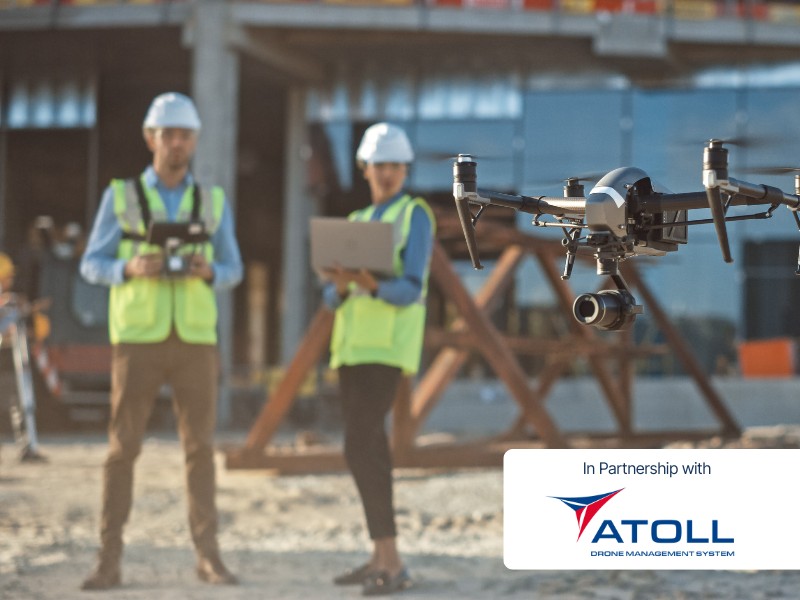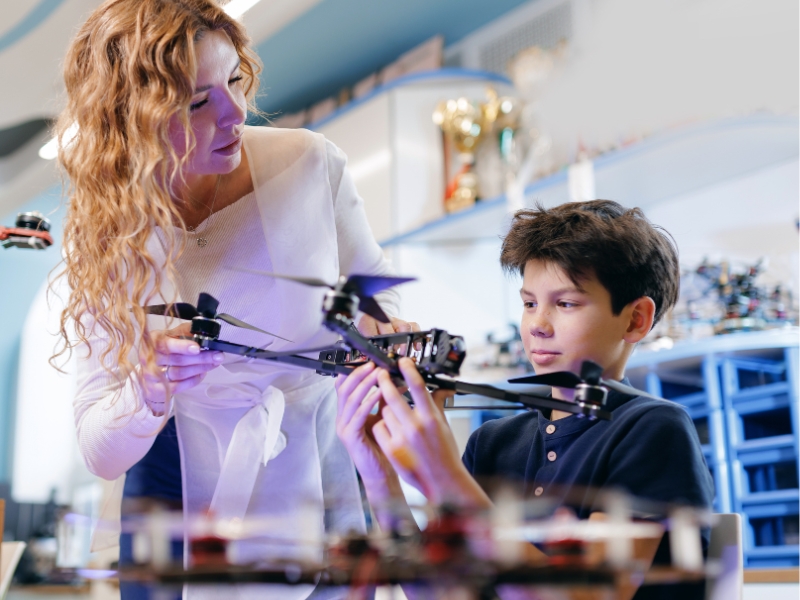
The use of drones in education can give students at all levels a practical and exciting way to explore real-world technology and its applications in areas such as coding, engineering, mapping, media and more. From secondary-school STEM activities to specialist university courses, drones connect classroom theory with tools that are increasingly being used in industries such as surveying, agriculture, infrastructure and environmental sciences.
This brief article explores ten uses of drones in education, showing how they can be used to enhance teaching and learning experiences at various levels of study.
If your school, college, university or training organisation operates drones, insurance may also form part of your operational planning. You can find out more about commercial drone insurance from Coverdrone.
1. Teaching Coding and Computational Thinking
It is no secret that technical and digital literacy are becoming more important as technology (including AI) becomes more embedded in our daily lives, and drones can play an active role in technological education. For example, programmable drones give learners immediate feedback on the code they write. A simple sequence can control take-off, movement, turns or landing, while more advanced exercises can introduce loops, variables and co-ordinates.
That gives students a physical outcome they can observe while learning programming concepts and getting comfortable with the technology involved.
STEM Learning’s drone teaching resources are a powerful example of how drone technology can be incorporated into STEM education, including engineering, computing and discussion of real-world drone applications, applications which will continue to grow significantly in the years to come.
2. Bringing Physics and Maths to Life
A drone flight can provide a practical setting for subjects such as forces, motion, speed, distance, angles and coordinates. Students can calculate how far an aircraft should travel, compare planned and actual flight times, or examine how changes in weight, power or weather conditions affect performance.
The aircraft also provides a visible example of several systems working together, including motors, propellers, batteries and flight-control software.
3. Exploring Engineering and Design
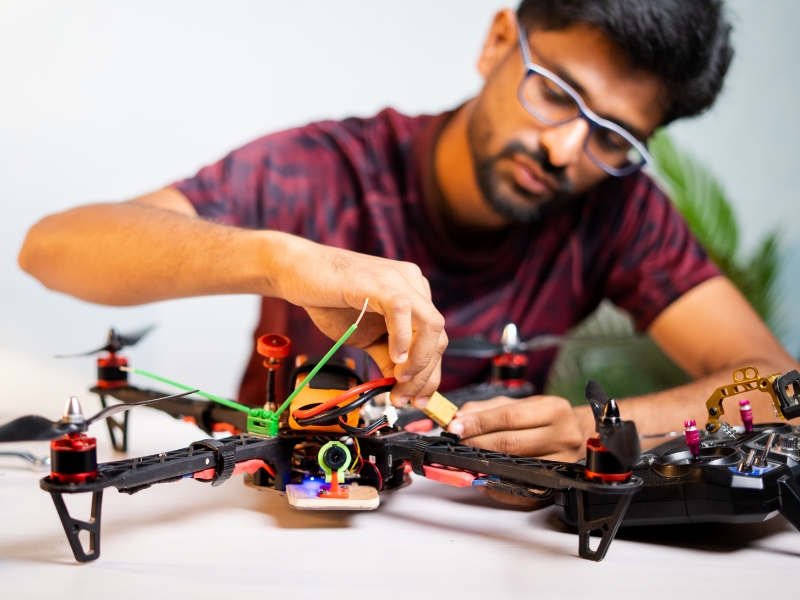
Drones can support engineering projects because students can examine the relationship between airframe design, propulsion, electronics, sensors and software.
Depending on the equipment and age group, activities might include identifying components, comparing different drone designs, testing payload concepts or even examining why manufacturers make particular design choices.
This can introduce systems thinking and the practical trade-offs engineers make between weight, endurance, stability and capability.
4. Learning Mapping, Geography and GIS
Aerial imagery gives geography and surveying students a different way to study landscapes and spatial data. Drone images can introduce mapping, photogrammetry, three-dimensional modelling and Geographic Information Systems (GIS).
These techniques also have direct applications beyond education. Surveyors, environmental specialists, construction professionals and land managers to name but a few can use drone-generated imagery and data to understand physical environments in greater detail.
At higher-education level, Swansea University’s MSc in Environmental Drone Remote Sensing provides a clear example of specialist teaching focused on collecting and analysing data using drone-mounted sensors.
5.Studying the Environment and Agriculture
Drones can help students understand how data is gathered from land, vegetation and natural environments. Depending on the sensor, an aircraft can capture standard photography alongside information from thermal, multispectral or other specialist systems.
That creates opportunities to explore subjects including crop monitoring, conservation, land management and environmental change.
Swansea University’s environmental drone remote sensing course, for example, covers the creation and use of high-resolution remotely sensed data, showing how drone technology can form part of advanced environmental study.
Educational drone projects can involve increasingly sophisticated aircraft, cameras and sensors. Where an organisation is operating drones as part of its professional activities, it can be useful to consider how the aircraft, associated equipment and potential liabilities fit into wider risk management activity.
Explore Coverdrone’s commercial drone insurance for more information about the insurance options available to professional drone operators.
6. Developing creative photography, video and media skills
For media students, a drone provides an aerial camera platform alongside the aircraft itself. Students can learn about shot planning, composition, movement, continuity and the practical limitations of aerial filming.
The footage can then become part of a wider production exercise involving editing, sound, narration or reporting.
This encourages students to plan the finished story and decide what the aerial perspective needs to contribute before a flight takes place.
7. Supporting Writing and Visual Literacy
Students do not need to fly a drone themselves to learn from drone imagery.
Aerial photographs and video can be used as prompts for descriptive writing, geography exercises, historical interpretation or discussions about how a difference in perspective changes what we notice in a given situation.
For example, a class could compare an aerial view with a ground-level photograph of the same location, identify features, make observations and explain how each viewpoint affects their understanding.
8. Building Teamwork and Project Management Skills
As a multi-faceted activity, drone operations naturally divide into different responsibilities. A supervised student project might involve planning a flight, preparing and inspecting equipment, undertaking pre-flight checks, observing the flight and monitoring conditions, recording information, and analysing the results afterwards.
Working through those stages is a great way to give students experience of briefing teammates, following and communicating processes, documenting decisions and reviewing outcomes and learnings.
All of these skills are transferable and have applications across a wide range of technical and non-technical careers.
9. Connecting Education with Real Drone Careers
Drone technology is used across areas including surveying, construction, agriculture, environmental science, archaeology, and media, and this is growing every day.
Using drones in education can, therefore, introduce students to the wider job market and technical disciplines surrounding the aircraft.
Through national associations and networks like ARPAS-UK, Career opportunities also extend beyond piloting. Drone projects can involve data processing, GIS, engineering, software development, sensor technology, video production and operational planning.
Specialist courses such as Swansea University’s Environmental Drone Remote Sensing MSc demonstrate how drone skills are being incorporated into career-focused higher education.
10. Teaching Flight Planning and Responsible Drone Operation
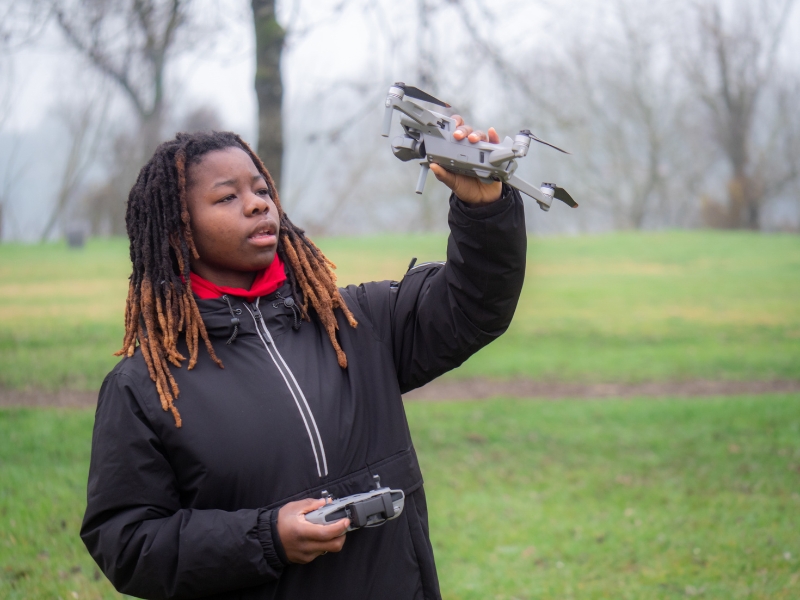
For students learning how drones are operated, preparing for a flight can form part of the lesson.
This can include understanding the intended location, checking relevant airspace information, identifying hazards, preparing the aircraft and recording the flight plan. For those interested in drones, building good decision-making habits like these early can make a significant difference to how they approach drones.
For UK-based educational activities, the Civil Aviation Authority’s Drone and Model Aircraft Code provides official information about the rules that apply to drone flying.
Responsible operation also includes considering the wider risks associated with a flight. Our guide to what drone insurance covers can help operators understand some of the insurance considerations involved.
Using Drones as an Educational Tool
The strongest educational uses of drones start with a clear learning objective and use the aircraft as a practical tool to reach it. A coding lesson, mapping exercise or engineering project gives students a defined reason to use the technology and an output they can review afterwards.
Schools, colleges and universities considering practical drone activities should also consider safe operation, appropriate supervision, the flying environment and any relevant privacy or safeguarding requirements.
Organisations using drones for education, training, research or other professional activities may also need to consider the insurance arrangements surrounding their operations.
Click below to get a quote for commercial drone use in your school, college, or training organisation.