Last updated: 30th June 2026
Over the last few years, drone use in construction has accelerated as drones become an increasingly practical way for construction firms, contractors, surveyors and project teams to understand what is happening across a site. From aerial surveys and progress monitoring to inspections, mapping and safety reviews, drones can provide a clearer view of work in progress and help teams make more agile, more informed decisions.
Construction sites are complex environments. They often involve multiple contractors, restricted access areas, changing ground conditions, heavy plant, temporary structures and strict safety requirements. In that setting, the ability to capture accurate aerial imagery and site data can be highly valuable.
Drones used in construction can support work throughout the project lifecycle, from early-stage planning and site assessment through to handover, maintenance and marketing. However, commercial drone operations also need to be planned properly. Operators need to think about safety, permissions, regulatory requirements, data handling and insurance before flying on or near a live construction site.
This guide explains how drones are used in construction, the benefits they can provide, the risks operators need to consider, and why suitable commercial drone insurance matters.
Contents
- How are Drones Used in Construction?
- Why Construction Companies Use Drones
- Drone Surveying and Mapping in Construction
- Construction Site Inspections Using Drones
- Progress Monitoring and Site Reporting
- Safety, Quality Control, and Site Logistics
- Environmental Monitoring and Stakeholder Communication
- The Risks of Using Drones on Construction Sites
- Why Construction Drone Operators Need Specialist Insurance
- Drone Insurance for Construction Companies and Contractors
- Final Thoughts
- Frequently Asked Questions
How are Drones Used in Construction?
Drones are used in construction for surveying, mapping, inspections, progress tracking, site monitoring, safety reviews, quality control, environmental assessments and aerial photography. They enable construction teams to collect visual information from above, often more quickly and safely than traditional ground-based methods.
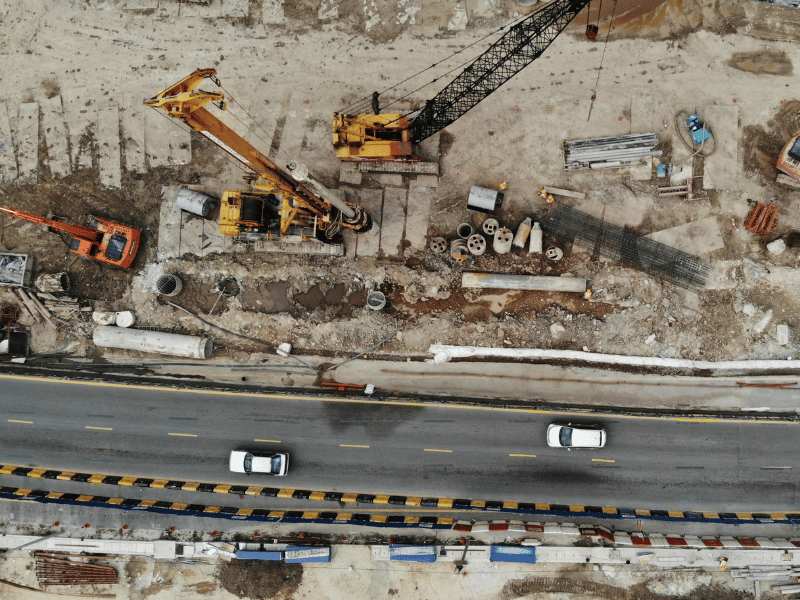
A key value add of a construction drone is perspective. A site that may look fragmented from the ground can often be understood more clearly from the air. Aerial images and video can show access routes, storage areas, potential hazards, site boundaries and progress across the whole project.
Common drone applications in construction can include:
- aerial surveys and site mapping/environmental monitoring
- structural inspections (e.g. roof, façade) and quality control
- progress monitoring and project reporting
- health and safety reviews
- materials monitoring
For project managers, site managers, surveyors, engineers, architects, developers and clients alike, drones help to create a shared and objective visual record of the site. Instead of relying only on subjective written updates or ground-level photographs, teams can use drone data to support better discussion and decision-making.
Why Construction Companies Use Drones
Construction companies use drones because they can make site information easier to capture, review and share. On large or complex projects, visibility is often one of the biggest practical challenges.
Teams need to understand quickly where work has reached, whether any issues are developing, and how different parts of the site relate to one another. Drones support this, and they can also help teams identify issues earlier, particularly where a problem is easier to see from above than from ground level.
For example, a drone may help reveal access restrictions, damage after bad weather or visible differences between completed work and the original plan. This does not replace the professional judgement of inspection teams or site management, but it can give those teams better information to work with.
Drone Surveying and Mapping in Construction
Drone surveying is one of the most established applications of drones in construction. By capturing aerial imagery and site data, drones can support land surveys, topographic surveys, mapping, terrain analysis and measurement work.
At the start of a project, drone surveying can help teams assess boundaries, access points, surface conditions and potential obstacles. For larger construction sites, this aerial visual perspective can make early planning more efficient and easier to explain to stakeholders.
Drone mapping for construction can also be used as a project develops. Repeated flights can show how sites change over time, allowing teams to compare current conditions with earlier records. This can be especially useful for sites where progress needs to be documented regularly and carefully.
In short, the outputs offered by drones can help technical teams analyse the site while also making complex information easier for clients and other stakeholders to understand.
Construction Site Inspections Using Drones
Construction site drone inspections can be useful when teams need to assess areas that are difficult, expensive or risky to access manually, such as roofs, façades, scaffolding, bridges, and towers.
In many cases, a drone can provide an initial visual assessment before people are sent into an area. That can help teams plan access more safely and decide whether a closer inspection is needed. It can also reduce disruption on site, particularly where scaffolding or temporary closures would otherwise be required for a basic visual review.
Drones can also help after adverse weather, damage or a suspected site issue. A fast aerial inspection may help teams understand the scale of an issue, identify immediate hazards and decide on the next practical steps quickly, before it becomes a problem.
Progress Monitoring and Site Reporting
Progress monitoring is another major reason for using drones in construction. Regular aerial photography or video can provide a clear visual record of how work is developing over time.
This is valuable because construction reporting often involves many different audiences. Site teams may need detailed operational information, while clients, investors or senior stakeholders may need a clearer overview of progress. Drone photography and footage can support both needs by showing the scale and status of the project in a format that is easy to understand.
For project managers, drone imagery can help compare completed work against project milestones. It can also support discussions about delays, materials, and contractor activity. When captured consistently, aerial records can help to reduce uncertainty and support better decision-making throughout the project.
Safety, Quality Control, and Site Logistics
Safety is one of the strongest practical arguments for drone use in construction. Live construction sites often involve work at height, moving vehicles, machinery, restricted zones, and uneven surfaces. A drone can help teams review an area remotely before deciding whether people need to enter it, mitigating the risk to them.
Drones can also support quality control by capturing images or footage at key stages. Aerial views can reveal inconsistencies, damage, or layout issues that may be missed during routine site movement. They can also help site teams review stockpiles, plant locations, storage areas and access routes, supporting better logistics planning.
Drone use does not remove the need for proper safety planning. Flights still need to be risk assessed, and the presence of a drone can introduce its own hazards if the operation is poorly planned. However, when operated professionally, drones can support safer inspection planning and provide useful site intelligence at every stage of a project.
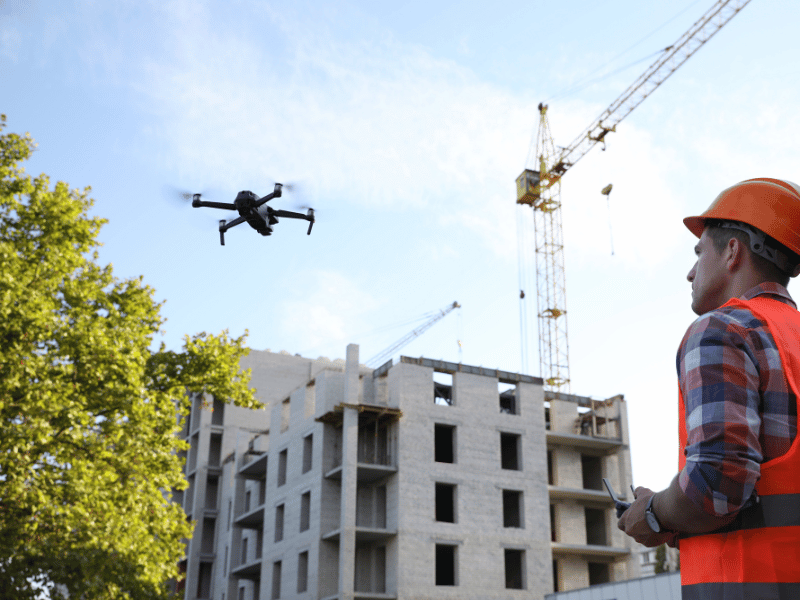
Environmental Monitoring and Stakeholder Communication
Construction projects often need to consider their impact on surrounding land, such as natural habitats and residential areas. Drone imagery can support environmental monitoring by helping teams assess the areas affected by construction activity.
Developers, contractors and construction firms may use drone footage for client updates, case studies, presentations, websites, social media and completion videos.
As with any commercial drone work, these flights still need to be planned properly, with consideration given to permissions, site safety, privacy, data handling and insurance.
The Risks of Using Drones on Construction Sites
Drones can bring significant benefits to construction projects, but they need to be used responsibly. Construction sites can be challenging places to fly because conditions change quickly. People, vehicles, cranes, scaffolding, power lines, dust, debris and weather can all affect the outcome of a flight.
There are also practical questions around responsibility. A construction company may operate its own drone, hire a specialist drone operator or ask a subcontractor to capture footage. In each case, it should be clear who is responsible for the flight, what permissions are needed, how the work will be risk assessed and what insurance is in place.
Before flying on or around a construction site, teams should consider:
- who is operating the drone
- what permissions or authorisations are needed
- whether suitable commercial drone insurance is in place
- how the flight fits into the site risk assessment
- whether nearby people, property or public areas could be affected
- how imagery and data will be stored or shared
Privacy and data protection should also be considered. Drone footage may capture workers, neighbouring properties, public spaces or commercially sensitive information. Clear processes around data capture, storage and sharing can help reduce the risk of issues later.
Why Construction Drone Operators Need Specialist Insurance
Commercial drone use in construction usually requires specialist drone insurance because the drone is being used for business activity. This could include surveying, inspections, mapping, progress monitoring, marketing footage or any other work carried out for a construction firm, contractor, surveyor, developer or client.
Standard public liability cover may not be suitable for drone operations. Drones are aircraft, and commercial operators need to make sure they have appropriate aviation liability cover for the work being carried out (we advise customers to check the rules and regulations in the region(s) in which they operate.
For construction drone work, insurance should reflect the nature of the flight. A policy may need to account for third-party injury or property damage, accidental damage to the drone, equipment cover, cameras or sensors, the country of operation and the required liability limits in the country of operation.
Construction businesses should also pay close attention to policy structure. The way liability limits are applied can matter when a client, contract or regulatory requirement asks for a specific level of cover. Operators should understand whether their cover meets the relevant requirements before flying.
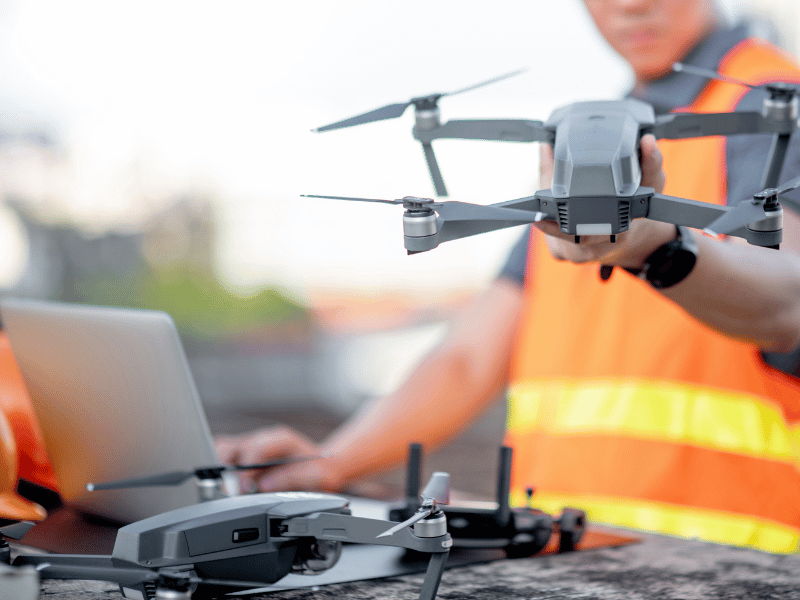
Drone Insurance for Construction Companies and Contractors
Construction businesses may use drones in several different ways. Some operate drones internally, while others commission external operators for surveys, inspections or progress footage.
If the business operates its own drone, it should make sure the policy reflects the actual work being carried out. If an external operator is hired, the construction company should ask for evidence of suitable commercial drone insurance before the work begins. It should also check that the operator’s cover is valid for the type of work, the location, the aircraft and the commercial purpose of the flight.
This matters because construction projects often involve contractual responsibilities, third-party risks and valuable property. If something goes wrong during a drone operation, unclear responsibilities or unsuitable insurance can create avoidable problems in the event of a claim.
Final Thoughts
Drone use in construction can support better surveying, inspections, mapping, progress monitoring, safety management, quality control and project communication. For construction firms, contractors and surveyors, drones provide a practical way to see more of the site, capture useful data and make better-informed decisions.
The benefits are strongest when drone use is planned properly and integrated into the wider project process. Construction sites are complex environments, so operators need to consider safety, permissions, documentation and insurance before flying.
If you use drones for construction work, or you are commissioning drone work for a construction project, make sure the insurance reflects the way the drone is being used.
At Coverdrone, we provide specialist drone insurance for commercial operators, including construction firms, surveyors, inspectors and contractors, so click the button below to get a quote today.
Frequently Asked Questions
How are drones used in construction?
Drones are used in construction for aerial surveying, mapping, site inspections, progress monitoring, safety reviews, quality control, environmental monitoring and project photography. They help construction teams capture a clearer view of the site and make more informed decisions.
What are the benefits of drones in construction?
The main benefits of drones in construction include improved site visibility, faster data capture, safer inspection planning, clearer progress reporting and stronger project documentation. They can also help teams identify issues earlier by showing the site from an aerial perspective.
Do construction companies need drone insurance?
If a drone is used for commercial construction work, suitable commercial drone insurance is usually required. This may include aviation liability cover that meets the relevant regulatory requirements. Construction companies should check whether they are operating the drone themselves or hiring an external operator.
Can drones be used for construction site inspections?
Yes. Drones can be used for construction site inspections, particularly where teams need to assess roofs, façades, elevated structures, plant, boundaries or hard-to-reach areas. They can provide an initial visual assessment and help teams decide whether further inspection or access equipment is needed.
What should construction companies check before hiring a drone operator?
Construction companies should check that the operator has suitable commercial drone insurance, relevant permissions, appropriate experience and a clear process for planning the flight safely. They should also confirm that the cover is valid for the type of work, location and site activity involved.